

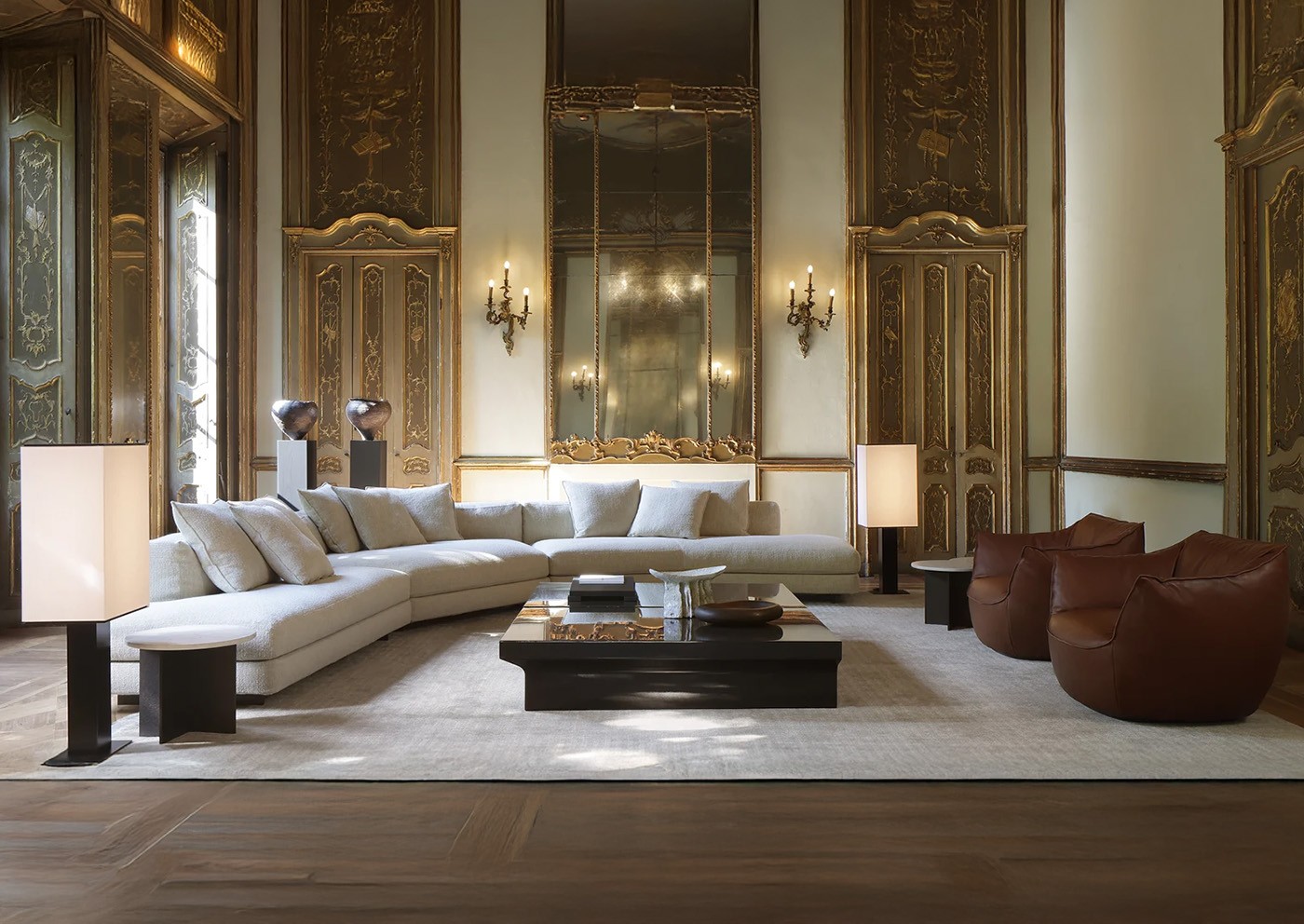
Surfaces and textures for a coherent design in your home
Almost no one can put a name to what they feel when entering certain spaces. There is something that holds everything together, but it isn’t the sofa, it isn’t the chandelier. It’s the material. Or rather, the way materials “speak” to each other: how they pass light along, how they yield visual weight, how they coexist without overpowering one another. Material coherence is the reasoning that distinguishes a project designed with intention from a mere sum of good intentions.The red thread: the invisible continuity of space
How is this subtle understanding woven between the rooms of a home? Through what we define as a fil rouge of design. We’re not talking about a manifest color or a theme repeated in a didactic way, but about a latent connection that guides the eye as it moves from one environment to another.This connection can hide in the profound undertone of a grey stone that converses with the warm veining da boucle fabric in the living area, then emerging again in the metallic accent’s gradation.
True design is a constant yet discreet invitation. A presence that does not impose itself, but ensures the liquid fluidity of home architecture.
The principles of pairing
To combine interior design finishes with sartorial rigor, it is essential to master the sensory balance of temperatures and the visual weight of surfaces.Thermal balancing
A cold and monumental surface, like a Carrara marble kitchen worktop with its sculptural veining, needs the tactile counterweight of warmth. It calls for the embrace of brushed wood or the softness of a fabric with a generous weave. If everything is glossy, the space repels; if everything is matte, it flattens.Visual hierarchy
The secret to avoiding visual chaos when different textures coexist lies in the discipline of volumes. Choose a dominant material that defines the mood of the space and let the others act in support, enriching the environment without raising their voice to capture attention.Micro-coherence: where technique becomes visual emotion
Excellence, the kind that can transform a home into a work of art to be lived in, lives where the distracted eye does not look. It reveals itself at points of contact, in small yet crucial details of transition.Great design celebrates the primordial meeting of materials. It is the exact moment when the living, warm fiber of parquet brushes against the geometric, austere purity of a resin—or where a millimetric metal profile frames a change of vertical surface.
These technical nodes should not be hidden; they should be drawn. Turning a functional junction into an elegant graphic line means making interior architecture, elevating a structural boundary to pure pvisual poetry.
The test of time (and of the evening)
A practical tip, often underestimated: never judge a material in just one moment of the day.A material must be understood in the real conditions in which it will be lived with. During the design phase, we study samples by recreating the exact lighting conditions of the rooms: how does that oak react to north-facing light at ten in the morning? What undertone does the marble take on at seven in the evening, when the warm lights come on?
The perfect material is not the one that strikes at first glance, but the one that knows how to change fluidly, bringing a sense of profound calm in every moment of the day.
Beyond the surface: Spazio Schiatti’s signature
Choosing the right materials is never only an aesthetic matter—it is an act that defines how you will move through your home, how you will feel, how you will perceive the space, and how you will live in each environment.Spazio Schiatti works precisely on this:understand first before proposing. Every project begins with a conversation about how you use the home, and what you want to find when you come back at night. Finishes and materials come later, as a concrete response to those questions. Do you have a project in mind? Tell us with a tailored consultation for you.