

How to avoid clichés and design with elegance
There’s a misunderstanding that often comes up when talking about furnishing a home by the sea: the idea that, to “feel truly by the sea,” the house must state it explicitly. And so you see blue and white in heavy doses, a few more or less ironic nautical references , and that somewhat “standard holiday home” atmosphere that may be fun at first, but eventually wears you out. And yet the most interesting seaside homes do exactly the opposite: they don’t imitate the coast—they interpret it.
This is an approach that appears in many international guides: put aside shells and clichés, focus on more essential and sensible choices, where even a single detail (a fabric, a piece of wood, a local artwork) becomes a story, not decoration.
A new light for your home
The interiors of a seaside home have something extra—an element that is often missing in the city: the light that changes rapidly and a much more direct relationship with the outside. Here the project does not begin with the furnishings you want to choose but with what you feel and see in these rooms.
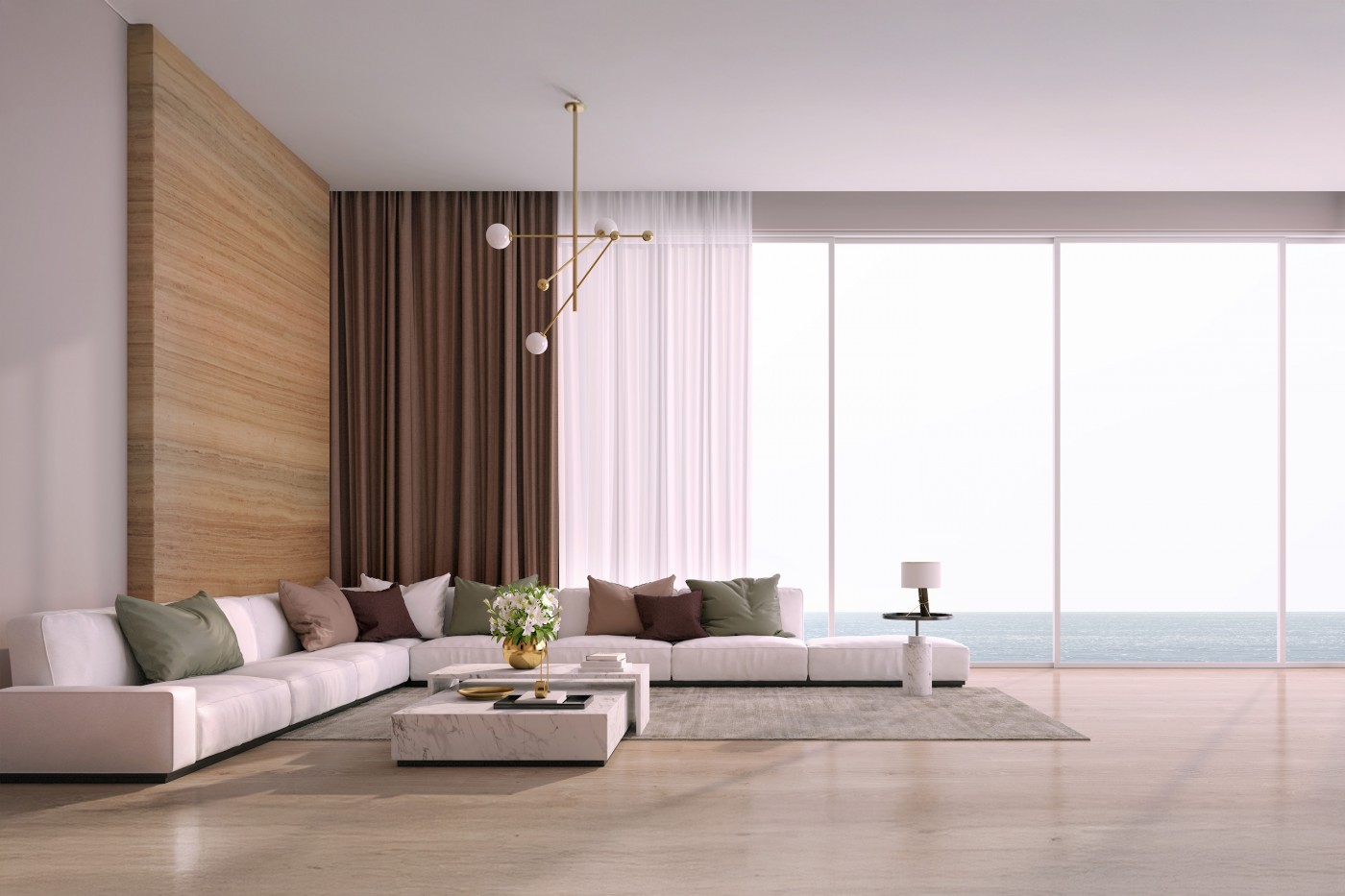
If you have broad views of the sea, the furnishings must take a step back: not because they should be anonymous, but because the true scenography is already there. If, instead, the light comes in sharply—maybe at certain hours it dazzles—then you need a strategy: matte finishes, textures that absorb, curtains that filter without blocking. It’s a subtle difference, and yet it changes everything: seaside home décor stops being a collection of pieces and becomes an atmosphere that can stand up to everyday life.
Coastal chic style
When we talk about coastal chic style, it’s easy to slip into something overly decorative. In reality, the most interesting version is the more essential one: clean lines, quality of materials, and high comfort, and quel a sense of lightness that has nothing to do with a printed nautical motif, but rather with the way the home “breathes”.
Sophisticated coastal chic is a balance: a substantial sofa with clean, streamlined shapes, a table with a tangible presence, fabrics with weave and depth (linen, heavy cotton, bouclé where it makes sense), and few objects—chosen well. You don’t need to fill the home. You need to compose it. And if it feels like you have “too much emptiness,” it’s often because you haven’t yet found the right hierarchy among light, volumes, and surfaces.
Color palette for a seaside home
Blue, white, and coral red are perhaps the colors that most directly recall a seaside home. Here, there’s a rule that seems obvious but isn’t: don’t choose the “sea” colors—choose the colors of the landscape.
An elegant seaside-home color palette is rarely a bold, decided blue. It’s often made up of tones that don’t tire and work beautifully with strong light: warm, matte white, sand, rope, dusty gray, greige, light woods. Then, if you want to add a touch of colour, keep it subtle: a sage green, a very light terracotta, or graphite used as a graphic accent rather than the main focus. The effect is immediate: the beach house style takes on a more mature, contemporary and, above all, personal feel.
Materials: beauty that withstands salt spray
Here we get into the more practical aspects – the ones that distinguish a project that ‘looks good in photos’ from one that stands the test of time. Furnishings for a beach house have to cope with salt spray, damp, UV rays and a different daily routine: you come in with salty skin and sand on you, with the windows open, and the air constantly affecting the surfaces.
That’s why it’s essential to choose materials and finishes that won’t deteriorate after the first season: varnishes and paints suitable for damp environments where needed, well-treated wood – preferably with a matt finish (which is much more resilient) – and surfaces that are easy to maintain without feeling ‘cold’ or plastic. Fabrics make a difference too: it’s not just a question of aesthetics, it’s a question of management and real comfort, when it’s hot and when the air feels heavier.
Indoor-outdoor continuity
If you want your home to truly feel like a contemporary seaside house, there’s an almost unavoidable step: creating continuity between indoors and outdoors. It doesn’t mean copying the same furniture; it means telling the same story.
A well-designed outdoor space isn’t an “extra.” It’s a room. And when the terrace, the portico, or the garden become part of the living area, the home changes level: it feels bigger, more fluid, and easier to live in.
The Talenti furnishings work when you want to add rhythm and contemporary character to outdoor spaces, with collections that hold the scene without weighing it down. Flexform Outdoor, on the other hand, is ideal if you’re looking for a quieter kind of luxury: deep seating, impeccable details, and that genuine-lounge feeling that keeps you outside even after the sun goes down
/span>
A seaside home that truly feels like you
Furnishing a seaside home is a more subtle exercise in balance than it seems. It’s not about pursuing a coastal aesthetic or replicating what you “expect” from a beach house, but about understanding how to make light, materials, and the rhythm of the spaces coexist in a setting that, in itself, already has a very strong character. The sea, in fact, doesn’t need to be described: it comes in through the windows, shifts the shadows, and shapes the colors of surfaces. It is a demanding interlocutor, rewarding measured choices and immediately testing the easy solutions.
This custom design is exactly that: not a “render,” but a principle that guides every decision and helps you arrive at a coherent, personal home—ready to be lived in.
Spazio Schiatti takes care of the selection of every detail: listens, selects, filters out what is superfluous, coordinates brands and finishes, offers youMake the right choices without wasting your time—above all, without having to worry about anything. The result is a seaside home that doesn’t chase a style: it puts its signature on it.