

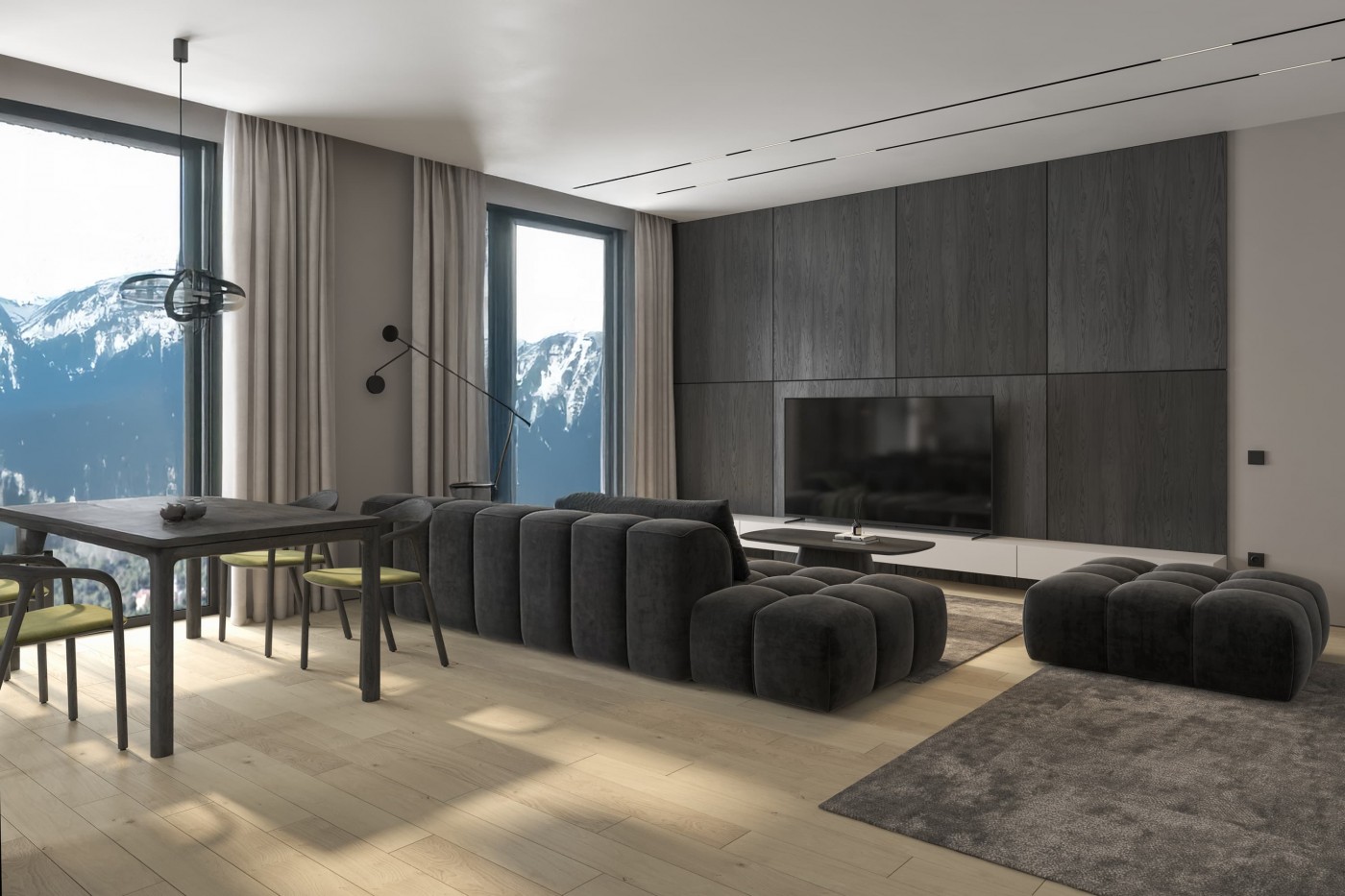
A journey between tradition and contemporary design
It often goes like this: keys in hand, emotion all around, and that almost unbelievable feeling of finally having found “the right space”. Then you step inside. Everything is white, tidy, flawless. Clean walls, neutral floors, impeccable fixtures—an open space that seems made to let the light breathe.Yet after the first few minutes, a more practical thought also comes in: “Where do I start?”
Because a new home, especially a home with an A energy rating—or at least with a high energy-efficiency rating—has technically already evolved, but it’s not yet yours. It’s a foundation. And if the foundation is clean and minimal, without a clear direction, it risks remaining just that: beautiful, yes, but impersonal.
If you’re looking for how to furnish a new home in Switzerland, here you’ll find a guide designed for those who truly need to find their way: concrete choices, priorities, mistakes to avoid, and a calmer way to approach a project that, often, becomes more demanding thanas much as you might expect.
New builds in Switzerland: minimal exteriors, interiors to write about
Anyone who has seen a building site or visited more than a few apartments knows it: the prevailing architectural style in new Swiss developments—particularly in Ticino—leans toward formal clarity. Essential volumes, restrained façades, controlled materials. Inside, the choice is almost “natural”: open-plan layouts, large windows, continuity between kitchen and living area.This is the perfect setting for a contemporary project. And, paradoxically, it is also the most challenging.
Because when space is neutral and rational, every decision is visible. Even the small one. Even the one made “on the fly,” because you have to decide quickly.
And here the issue arises: furnishing a modern open-plan living area doesn’t mean only choosing a beautiful sofa and a kitchen that’s well equipped. It means giving the space a hierarchy, making materials and volumes speak to one another, build a house that doesn’t look like a collection of objects placed side by side.
The specifications for new-build homes in Switzerland
The topic of the apartment specifications always comes up. Sometimes it’s a clear document, sometimes it’s a list of items, and sometimes it’s a “you can choose from these options” that sounds simple—until you realize that those options, in your home, you’ll see every single day.The finishes in a new-build specification are often designed to be:
- neutral
- compatible with different tastes
- easy to manage in terms of timing and supply
The point isn’t to demonize the specification. On the contrary: it’s a solid foundation. The point is to understand where to stick to the standard and where, instead, to make choices that truly change the perceptionrcezione di qualità.
Because the step up in quality, usually, doesn’t come with “something strange.” It comes with something coherent. With a project that has a thread running through it.
The difference between furnishing and building an identity
Furnishing a home in Switzerland means choosing an identity.And often you do it while you still have a thousand things in your mind: practicalities, timelines, work, family, moving, deadlines. The truth is that a new home is a blank page. And that’s a stroke of luck. But it’s also a responsibility.
Without an aesthetic direction, it often happens that even the right choices made individually, together end up saying nothing.
That’s where that strange feeling comes from: the home is new, but it doesn’t feel like you. And it’s not your fault: it’s simply that there’s no creative direction, and you can achieve that with a custom-designed project.
When minimalism becomes a project
We’re talking about minimalist interiors, because minimal is not cold in itself. Minimal becomes cold when it is “flat.” When everything is the same, everything has the same tone, and the home seems to have no depth.The minimal that works, instead, does one very precise thing: it chooses.
It chooses the guiding materials (few, but excellent), it chooses the rhythm between solids and voids, it chooses what must be the protagonist and what should remain in the background. And then it works with details: a grain, a light cut, a wall paneling system that solves storage and perspective, a finish that doesn’t “shout,” but makes its presence felt.
Sometimes very little is enough. But that little must be decided well.
Contemporary Swiss design and Italian design
In Switzerland, this kind of search is increasingly felt: rigor, quality, order - but with a little more warmth. A precise home, yes. But also welcoming. Not “out of a catalogue”. Real.From here the interest in contemporary Swiss design on one side, and on the other the growing demand for Italian design.
Italian design brings with it a culture of materials and proportion that works beautifully in minimal spaces: it doesn’t fill, it builds.
The most elegant synthesis is the one that you don’t immediately notice as “style”, but that you perceive as quality. You enter and think: “Everything here is exactly where it should be.”
Swiss interior design: the difference between choosing and designing
Choosing is not designing.When you look for an interior design or interior design service in Switzerland, what you need isn’t someone who shows you a thousand options. What you need is someone to help you make the right decisions, in a sensible order.
Pbecause if you get the order wrong, you get everything wrong:
- first, define the guiding palette and materials
- then consider volumes, containment, and framing elements
- then lighting and details
- then accessories and textiles
When interior design becomes a quality standard
The client isn’t always a private individual. Sometimes it’s an architecture studio, a developer, a real estate operator who needs to deliver value and consistency across multiple units: showcase apartments, evolving specifications, and replicable quality standards.In these cases, the goal is clear: <maintain a contemporary language, control costs and timelines, but raise perception.
For this reason, Spazio Schiatti has created a dedicated path for professionals designed to support developments and contracts with a solid direction—from defining choices through to execution.