

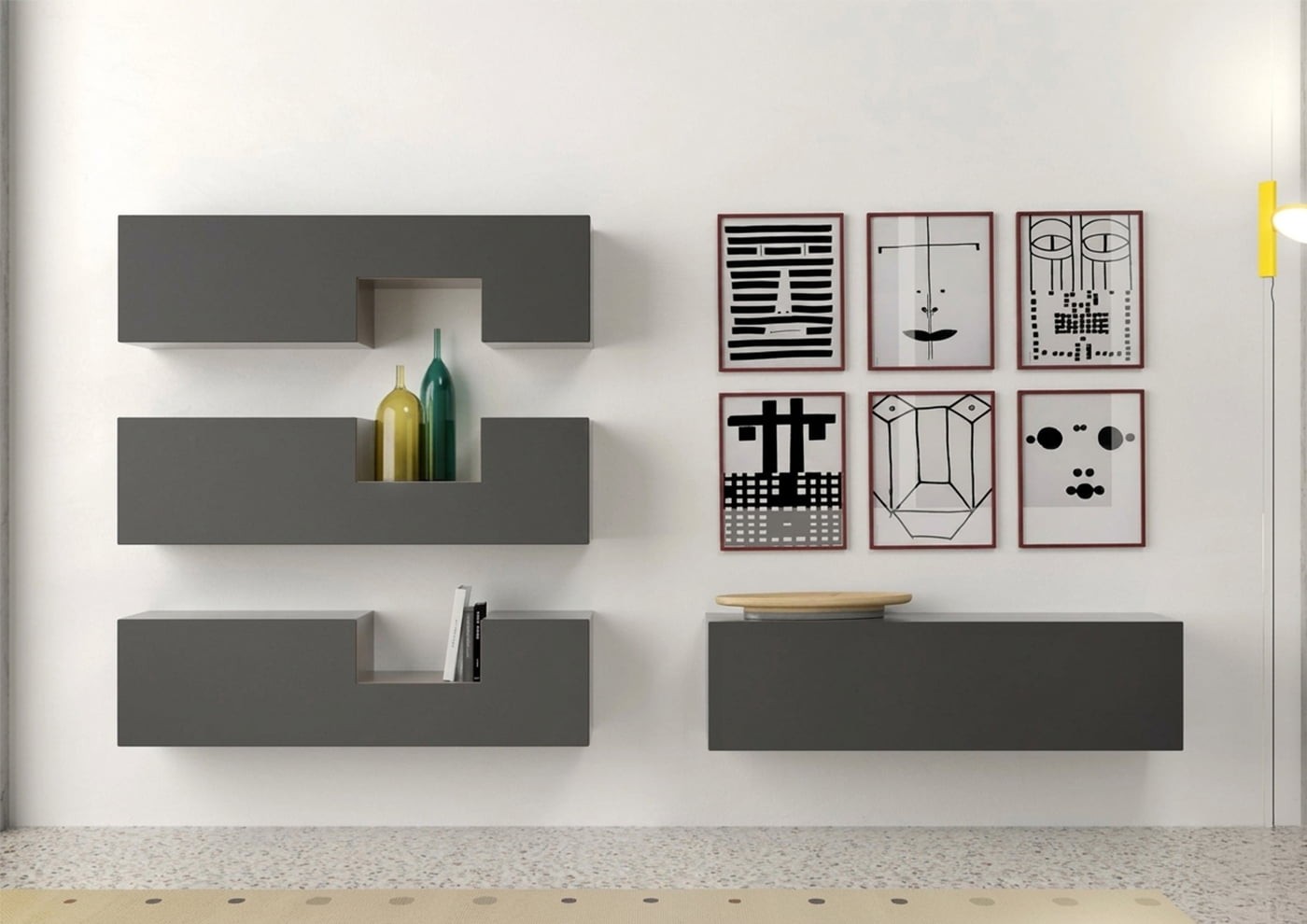
When interiors defy gravity
To enter a room and feel the instinctive need to open the windows, even when it isn’t warm. It happens when the interiors are saturated, weighed down by volumes that claim every centimeter of floor space. True contemporary luxury is not about adding, but freeing the line of sight.
For this reason floating furnishings are born: to create a visual void that allows light to glide through and the architecture to breathe.
Lifting volumes off the ground is not just an aesthetic whim; it means changing the specific weight of everyday life within our homes.
Suspending volumes to lighten the space
Every element inside a home occupies a physical space, but above all visually. A piece of furniture resting on the floor interrupts the continuity of surfaces and creates a clear boundary. On the contrary, a floating furnishing allows light and perspective to filter through, enabling the eye to move through the space in a fluid way.
This is where the lightness typical of contemporary interior design takes shape. The goal is to redistribute visual weight within the composition, without diminishing the stage presence of the furnishings.
Even an important volume can appear essential when it is lightened through correct proportions, reduced thicknesses, and careful planning of distances.
Space is not filled: it is orchestrated.
A new relationship between architecture and furnishings
Suspended furnishings have introduced a design language different from.
The home stops being a collection of separate blocks and becomes a continuum in which furnishings, walls, and surfaces speak to one another. Each piece of furniture enters into direct harmony with the architecture: a synergy fully expressed in the transparencies and modular systems of Rimadesio, in the extraordinary visual lightness of the solutions signed Lago, and in the geometric rigor and elegant refinement of the proposals Poliform.
It is an approach that works extensively on perception.
The floor, left clear, expands visual depth. Light flows beneath the volumes and guides the gaze along the surfaces. Even the most compact spaces gain air, because interruptions are reduced and everything appears more essential, almost suspended.
That is why floating furnishings find room not only in minimalist settings, but also in tactile, warm, deeply layered interiors. Lightness does not mean coldness; rather, it depends on balance.
The invisible rhythm of spaces
Every interior has its own visual cadence, shaped by alignments, pauses, and the proportions between solids and voids.
Some spaces feel instantly harmonious precisely because nothing interrupts the space’s rhythm: the volumes speak to one another, the surfaces maintain continuity, and the eye moves without abrupt interruptions.
Floating furnishings heighten this sensation. By lifting the volumes off the floor, a visual pause is introduced that makes the whole feel dynamic. It is a lightness that influences the very way the home is lived.
In this setting, modularity plays a key role: modular systems and flexible configurations allow agli spaces to evolve naturally, breaking beyond the static scheme of traditional furnishings.
When lightness meets matter
The strength of contemporary interiors often lies in the tension between lightness and material presence. To suspended surfaces are paired deep woods, natural stones and textures that bring stability back to the composition. It is precisely this contrast that gives character to the spaces.
An entirely weightless space would risk losing emotional depth; it needs elements that anchor it, introducing density and character. Lightness truly works only when it meets a component that balances it. The value of the project lies precisely here: in calibrating voids and solids, continuous surfaces and significant materials, lightness and grounded presence.
<
Designing space: the Spazio Schiatti experience
This design philosophy redefines the experience of living: interiors are freed from clutter, turning toward continuity and breathing room.
Choosing suspension, however, is not purely an aesthetic exercise. It requires invisible yet rigorous engineering: calculating high-level load capacities, studying wall structures, and selecting brands able to translate modularity into tailored standards.
At the Spazio Schiatti showroom in Desio, the interior design moves along this delicate balance, translating the challenge of gravity into bespoke solutions. A philosophy of lightness that does not stop within the walls of the home, but extends into the outdoor space thanks to brands such as Talenti, capable of transforming outdoor furnishings into genuine works of art floating in space, with complete visual continuity with the living area.
In this way, space becomes a perfect harmony between architecture, proportions, and perception. A tailor-made project that leaves room around objects and, precisely for this reason, makes them stand out even more.