

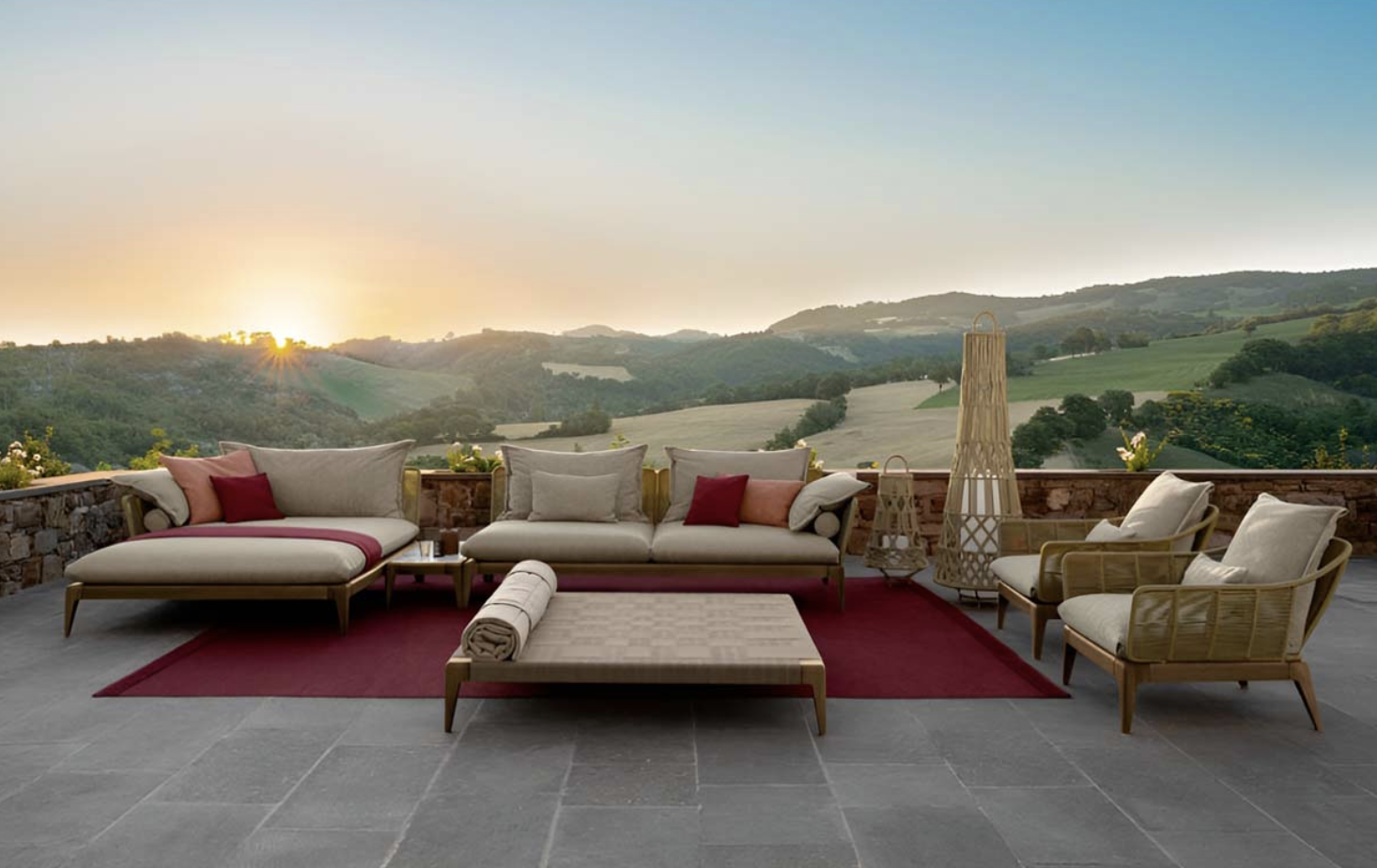
Designing outdoor spaces the way you design a home
There’s something in the air of March that changes everything. The light lingers longer, and outside, everything awakens: slow, quiet, inevitable.
It’s a subtle transformation—one that doesn’t announce itself. One day you realize you feel comfortable in the sun, that the air has a different weight, that the world beyond the window calls you. The outdoors comes back to life—and with it, the desire to truly live in it.
Your outdoor as an extension of the home
A terrace, a garden, a courtyard share the same spirit as an interior space: the same ability to welcome, to tell your story. And yet, in most cases they’re treated like an afterthought—something you set up later, with whatever budget and attention are left.
Outdoor design changes your perspective: it starts from the actual space, from orientation, from the way light moves throughout the day, and from the visual relationship with the indoor environments. Outside, light already shifts, shadows draw different geometries, materials change with the seasons. An outdoor doesn’t get “furnished”—it’s listened to, read, and interpreted. Only then will every choice find its place.
Outdoor furnishings: when materials make the difference
In outdoor interior design, durability is part of the project, not a separate technical variable to manage. A sofa that loses its structure after two summers, a seating piece that fades at the first rainy season—these aren’t surprises. They’re the result of decisions made too far upstream.
High-quality outdoor furnishings work on multiple levels at the same time: aesthetics, resistance to climatic cycles, coherence with the language of the interiors.
Treated teak, high-end synthetic fiber, powder-coated aluminum, outdoor ceramics: every technical choice carries a precise aesthetic.
The brands we work with share this depth—capable of bringing together beauty and longevity, season after season—and in our showroom in Desio, you can see, touch, and compare the collections in the dedicated outdoor exhibition area.
Ideas for outdoor furnishings that come from the space itself
Before choosing a sofa or a seating piece, it’s worth pausing on a few simpler questions:
How is this space used?
At what time of day?
How often?
Do you need shade, or are you looking for the sun?
Is the space experienced as a place of tranquillity or socialising?
A concept emerges from these answers. A pergola with integrated lighting and side screens completely redefines how a terrace is used – making it usable at times of day and in seasons that were previously off-limits
A dining area designed to blend visually with the interior blurs the boundary between inside and outside, without feeling forced. A lounge seating area proportionate to the space – not chosen by way of subtraction – transforms a courtyard into a place where people choose to spend time.
When a design project is based on this approach, every element takes on a clear purpose. The materials interact with the light, the proportions invite you to linger, and the whole conveys a recognisable vision.
Outdoor design: how to organise space into zones
A well-designed outdoor space reads like a natural ecosystem: there is a place where you arrive, one where you sit, one where you eat, and perhaps a more intimate spot where you feel at home. It is not a question of size – even a compact terrace can embody this logic, provided the proportions are carefully balanced and the spaces do not encroach upon one another.
Organising by zones does not mean dividing the space with clear-cut boundaries; it means giving each area its own identity – in terms of materials, heights and light – which distinguishes it without isolating it.
A change in flooring, the positioning of a vertical feature, the choice of different lighting: these are the cues that guide those using the space, without them even realising it. The result is an outdoor space that feels harmonious because everything seems to be exactly where it should be.
A garden furnished without an overarching vision is a collection of objects that do not complement one another. Coherence – in terms of materials, colour schemes, proportions and the relationship with the architecture – is what transforms a selection of items into a cohesive design.
This applies to private individuals seeking an outdoor space that matches the rest of their home. It applies, in a different way, to architects
Designing outdoor spaces with Spazio Schiatti
If you’re imagining an outdoor experience worthy of everything else—or you’re designing a space for a client—come visit us in our showroom in Desio. More than 5,000 sq m, with a dedicated outdoor section: it’s where you meet the right materials, accurate proportions, and textures you can actually touch—so the project moves beyond an idea and becomes a true choice.